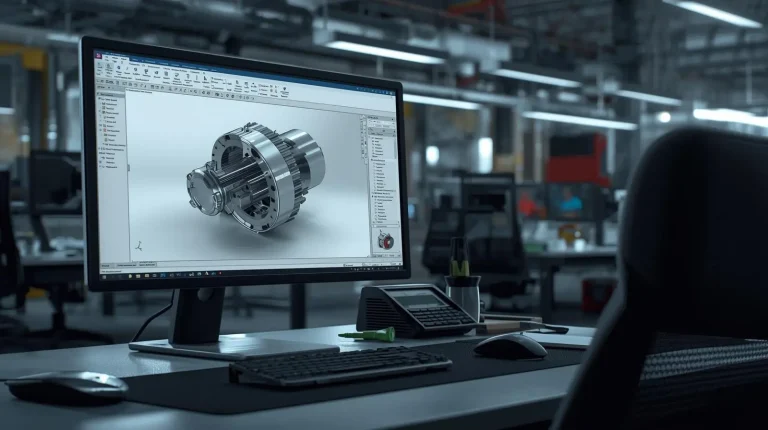


Converting STL to STEP in SolidWorks – Modern engineering projects often start with mesh-based geometry generated through scanning or legacy design data. While mesh representations accurately describe shape, they lack the structured intelligence required for professional CAD environments. Transforming this data into a fully editable solid model is a critical step for design modification, validation, and manufacturing.
At STLXYZ, this transformation is treated as an engineering process rather than a simple file operation. The objective is to rebuild geometry with full control over dimensions, features, and tolerances—ensuring the final model behaves like a native CAD design.

Challenges of Working with Mesh Geometry
Mesh data is composed of countless triangular facets. Although visually precise, this structure introduces several limitations for engineering teams:
- No parametric dimensions or feature history
- Limited control over surface continuity
- Difficulty integrating models into assemblies
- Incompatibility with many manufacturing workflows
Without reconstruction, mesh-based models remain static references rather than functional design assets.
Rebuilding Solid Geometry with Engineering Intent
A professional workflow focuses on restoring design intelligence. This involves analyzing the original geometry, identifying functional surfaces, and recreating features using parametric logic. Planes, cylinders, fillets, holes, and profiles are rebuilt to reflect real-world functionality rather than raw surface approximation.
The result is a solid model that can be edited, measured, simulated, and manufactured with confidence.

Accuracy and Validation
Precision is critical when transitioning from unstructured geometry to solid CAD. Each reconstructed model undergoes validation to ensure dimensional accuracy and surface continuity. Deviations are carefully measured against the original data to confirm compliance with engineering tolerances.
This validation step ensures the final model is suitable for production, tooling, and downstream engineering processes.
Applications Across Industries
Structured CAD reconstruction supports a wide range of applications:
- Redesign of existing mechanical components
- CNC machining and tooling preparation
- Assembly fit and interference analysis
- Simulation and performance testing
- Long-term digital archiving of physical parts
Industries such as automotive, industrial machinery, aerospace, and manufacturing rely on this approach to maintain accuracy and repeatability.
Why Engineering-Led Reconstruction Matters
Automated solutions often generate simplified geometry that lacks true parametric structure. Engineering-led reconstruction prioritizes usability, editability, and long-term reliability—ensuring models integrate seamlessly into professional workflows.
STLXYZ applies this disciplined approach to deliver CAD models that support real engineering decisions rather than visual approximation.
Converting STL to STEP in SolidWorks
Transforming mesh geometry into structured CAD is a foundational step in modern product development. By rebuilding solid models with engineering intent, STLXYZ enables teams to move from raw data to reliable, production-ready designs that support precision, flexibility, and efficiency.
Converting STL to STEP in SolidWorks delivering clean, editable CAD models for engineering use. Contact us for more information.